
Non-Human Identity Is the CISO's #1 New Risk in 2026. Here's Why
 Val Tsanev
- Updated: September 22, 2026
- 6 min read


- Copied!

Your AI agents don't clock in, don't take breaks, and don't wait for approval before touching your CRM, your billing system, or your customer database. An agent may end up holding access to more systems than the employee who built it, particularly when permissions accumulate across multiple integrations. That's the quiet shift making agentic AI security an identity problem CISOs can no longer push to next quarter. A shift ExecWeb unpacked from the CISOs side at RSA 2025 as agent deployment accelerated across the enterprise.
According to Palo Alto Networks' 2026 Identity Security Landscape, organizations reported an average of 109 machine identities for every human identity, including 79 AI-agent identities per human. The research surveyed 2,930 cybersecurity decision-makers worldwide.
This article breaks down what agentic AI security actually means, why non-human identity (NHI) sits at the center of it, and what security leaders should do about it in 2026.
What Is Agentic AI Security?
Agentic AI security is the practice of protecting AI agents that can independently perform tasks, make decisions, access systems, and take action without step-by-step human approval. It covers the agent's identity, permissions, credentials, data access, behavior, and interactions with other systems, not just the safety of its outputs.
Unlike a chatbot that answers a prompt, an agent can chain several actions together: pull a record, call an API, update a file, notify a system. Securing that chain means securing everything it's allowed to touch.

What Is A Non-Human Identity (NHI)?
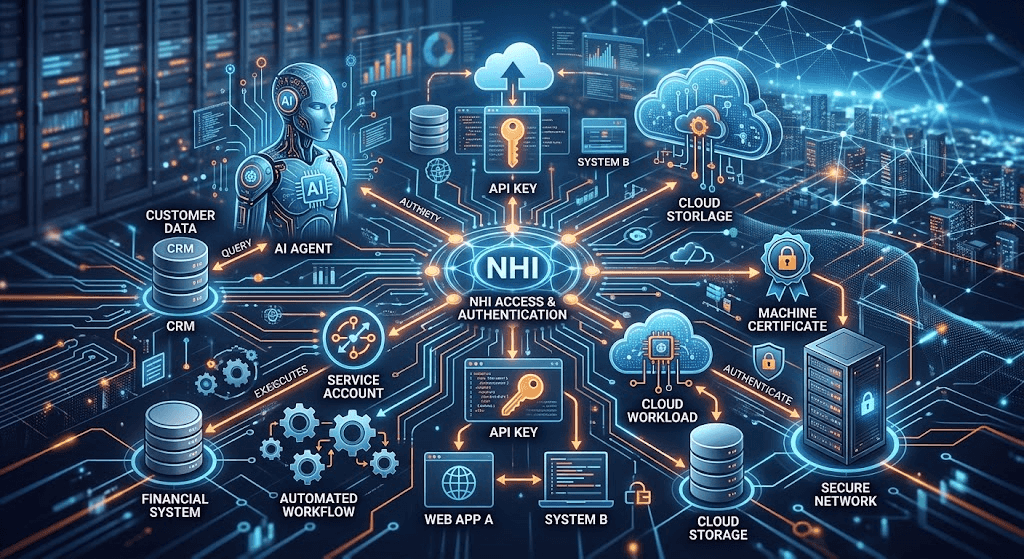
A non-human identity is a digital identity used by something other than a person, such as an application, service account, API-connected system, workload, or AI agent. It's how a system proves who (or what) it is before another system grants it access.
Enterprise environments already run on machine identities: API keys, OAuth tokens, service accounts, certificates. AI agents are simply the newest, fastest-growing category, and one that increasingly acts on its own.
Examples Of Non-Human Identities:
- An AI agent querying a CRM
- A service account running an automated workflow
- An API key connecting two applications
- A cloud workload accessing storage
- A machine certificate authenticating a service
Why Are AI Agents a Security Risk?
AI agents create risk because they can hold access to multiple systems and act without a human approving every individual step. AI agent security therefore has to address not only the model itself, but also the identities, credentials, permissions, and systems surrounding it.
These AI agent threats can become harder to contain when agents are connected to multiple systems and operate with broad permissions.
Excessive Permissions
An agent built to retrieve customer data shouldn't also delete records or touch financial systems, but broad, convenience-driven grants make that common.
Compromised Credentials
If an agent's API key or token leaks, an attacker may be able to inherit its legitimate access without needing to compromise a human user's credentials through phishing.
Autonomous Chaining
An agent that executes several connected actions in sequence can also propagate a mistake, or a malicious instruction, across systems before anyone notices.
How Do Non-Human Identities Relate To Agentic AI?
Non-human identities give AI agents, applications, workloads and services a way to authenticate to enterprise systems. The permissions attached to those identities determine what an agent can access and what actions it can take.
The chain looks like this:
AI Agent → NHI → Permissions → System Access → Actions
As organizations deploy more agents, the number of identities that need governing grows right alongside them often faster than teams expect.
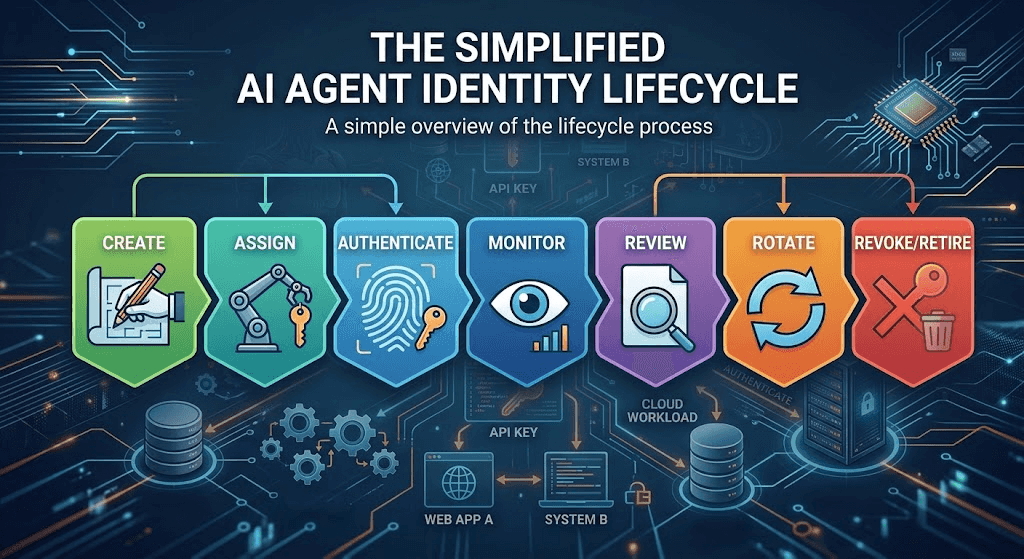
The AI Agent Identity Lifecycle
Create → Assign → Authenticate → Monitor → Review → Rotate → Revoke/Retire
Why Is Non-Human Identity a Top CISO Priority in 2026?
Non-human identity is becoming a top 2026 priority as the machine-to-human identity ratio continues to expand and AI agents become a rapidly growing category of machine identity. KPMG's 2026 Cybersecurity Considerations report lists managing non-human identities as one of eight key cybersecurity considerations for 2026. The report draws on insights from more than 20 KPMG cyber leaders worldwide, along with perspectives from senior technology executives and KPMG research.
Respondents to Palo Alto Networks' survey expect AI-agent identities to grow by 85% over the next 12 months, compared with 77% for machine identities overall and 56% for human identities.
These trends are increasingly relevant to CISO priorities 2026, particularly around identity, access control, AI governance, and machine identity management. They also align closely with ExecWeb's own breakdown of the top CISO challenges this year.
Security teams increasingly need to answer a short list of questions for every agent in the environment:
- What AI agents are running?
- Who created and owns them?
- What identities and credentials do they use?
- What systems can they reach?
- Are their permissions still necessary?
How Can Organizations Secure AI Agents?
Securing AI agents requires organizations to inventory every agent, assign controlled identities, apply least privilege, protect credentials, monitor behavior, and revoke access the moment an agent retires. No single control does the job alone; it takes layered identity discipline applied consistently.
Give each agent a distinct, attributable identity wherever possible. Shared credentials can make it difficult to determine which agent performed an action and complicate incident response, auditing, and access revocation.
1. Know Every Agent
Document each agent's purpose, owner, identity, and connected systems. An agent nobody can name is an agent nobody can govern.
2. Apply Least Privilege
Give an agent only the access its task requires read-only where possible, with no administrative access by default.
3. Use Zero Trust For AI Agents
Don't extend automatic trust just because an agent runs inside the perimeter. Evaluate identity, context, and behavior continuously.
4. Protect Machine Credentials
Rotate and securely store API keys, tokens, and certificates as part of a broader machine identity management program.
5. Monitor Agent Activity
Watch authentication attempts, API calls, data access, and anything that deviates from an agent's expected role.
6. Retire Access On Schedule
When an agent is replaced, its identities and permissions should be reviewed and revoked, not left dormant.
| Security Challenge | What It Means | What Organizations Should Do |
|---|---|---|
| Unknown AI agents | Teams may not know every agent operating in the environment | Maintain an AI agent inventory |
| Excessive access | An agent may hold more permissions than its task requires | Apply least privilege |
| Exposed credentials | Tokens, API keys, or secrets may be compromised | Protect and rotate credentials |
| Unclear ownership | No one may be clearly accountable for an agent | Assign a named owner |
| Limited monitoring | Suspicious activity may go unnoticed | Monitor identity and agent behavior |
| Forgotten identities | Retired agents may retain access | Review and revoke unused identities |
What Is the AI Identity Governance Gap?
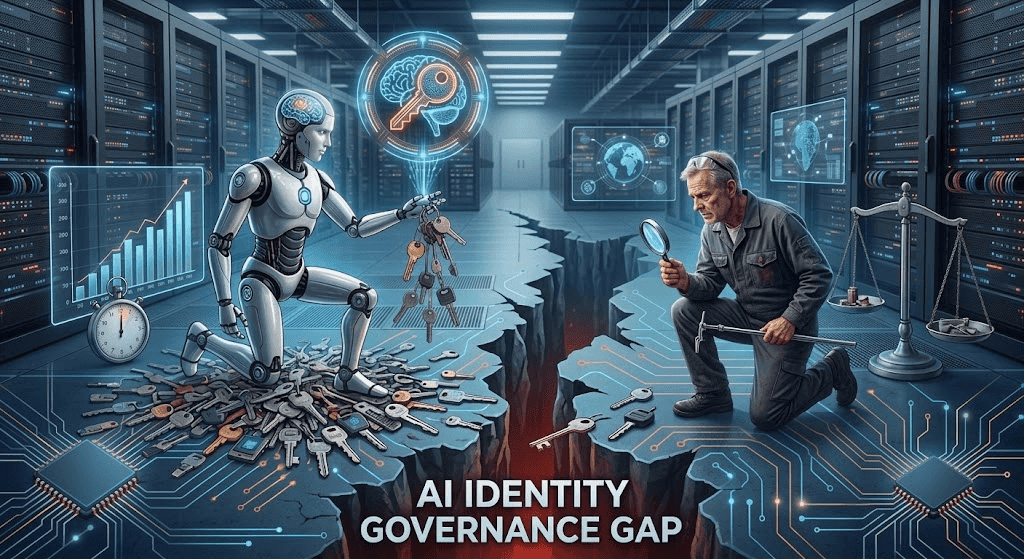
The AI governance gap is the distance between how fast organizations deploy AI agents and how effectively they can identify, control, monitor, and govern the identities those agents use. It widens whenever a business unit stands up its own agents without looping in security or IT.
Traditional identity programs were built around employees, contractors, and a relatively stable set of applications. Agentic systems break that assumption: they can be spun up in an afternoon, touch several services in one workflow, and outlive the person who created them.
Who owns an agent, exactly? It might be built by a developer, used by a business team, hosted by IT, and monitored by security with no single name attached to any of it. Closing the AI governance gap starts with assigning ownership across the full lifecycle: create, deploy, access, monitor, review, retire.
How Should Cybersecurity Vendors Reach CISOs About Agentic AI Security?
Vendors reach CISOs most effectively by framing agentic AI security around specific, answerable identity questions rather than broad statements about AI risk. Conversations that connect straight to visibility, access control, governance, and measurable outcomes land better than feature lists or fear-based pitches.
Instead of opening with "AI agents create new risk," a stronger opener asks: Can you identify every agent accessing your systems? Do you know what identities they use, and who owns them? Can you revoke access in minutes, not weeks?
Those questions turn an abstract AI conversation into a concrete security one which is exactly the approach ExecWeb recommends when positioning security technology to CISO audiences.
It also helps to tie the pitch to programs CISOs already run: identity and access management, zero trust, least privilege, machine identity management, and compliance. A solution that clearly slots into existing priorities is a far easier "yes" than one asking CISOs to build a new program from scratch.
AI Security Starts With Identity
AI agents bring real automation value, but that autonomy raises identity questions enterprises haven't fully answered yet: which agents exist, what they can reach, who's accountable, and when their access should end. That's why agentic AI security is inseparable from AI identity governance, machine identity management, and zero trust for AI agents.
The question every security team needs to keep asking is simple: who or what is acting, what can it touch, and why? Getting a consistent answer is quickly becoming table stakes for running AI at scale. For more on how security leaders are approaching this shift, ExecWeb's ongoing CISO coverage is a good next stop.
FAQs
How can you know which AI agents are accessing your systems?
You can maintain an inventory of AI agents, including their owners, identities, credentials, permissions, and connected systems.
How much access should you give an AI agent?
Give an AI agent only the permissions it needs to complete its specific task. Least-privilege access helps limit unnecessary exposure.
Who should be responsible for an AI agent?
Assign a clear owner to every AI agent. You should know who is responsible for its access, security, monitoring, and retirement.
What should you do if an AI agent is compromised?
You should quickly identify what the agent could access, revoke or rotate its credentials, and review its activity for suspicious behavior.
What should you do when an AI agent is no longer needed?
Review and revoke its permissions, credentials, and associated identities. Retiring unused agents helps prevent forgotten access from becoming a security gap.
- Copied!
- 0 views
- 0 comments


Comment